 01752 905790
 info@extra-help.co.uk
Your role may not include providing direct support to individuals with mental health problems, dementia and learning disabilities.
Having an awareness of the experiences of others can help you to identify any signs and symptoms as well as enabling you to work in ways that show compassion and understanding.
One in four adults in Britain will experience at least one mental health problem in any given year.
Examples of mental health problems include:
These three points will be discussed in more detail if you click the linked word above.
An individual may experience a mental health need as a result of: A traumatic event, such as an accident, a death in the family or as a result of war (Post Traumatic Stress Disorder (PTSD).A chemical imbalance in the brain. Genetics, for example, a person’s additional needs may be due to their DNA.
Dementia – A word used to cover many different conditions that affect the brain. These conditions cause a decline or reduction in abilities, including:
- Memory.
- Thinking.
- Reasoning.
- Communicating.
The Alzheimer’s Society estimate there are over 100 different conditions that fall under the dementia umbrella.
Someone who experiences dementia may feel confused, frustrated and frightened. A common symptom is short term memory loss; the individual finds it difficult to remember recent events or conversations. This can lead to them repeating stories or asking the same question over and over again.
Dementia is often thought to be a condition that only affects older people. However, dementia can affect anyone, at any age. The Alzheimer’s Society estimates that more than 40,000 people under the age of 65 live with dementia.
Types Of Dementia
The three most common types of dementia are:
Alzheimer’s disease is caused an abnormal build-up of proteins in the brain causing damage to the brain cells and their connections. Two of the proteins involved are called amyloid (which form plaques around brain cells) and tau (deposits of which form tangles within brain cells).
The cause of learning disabilities is not always known but they can be due to complications during birth which can lead to lack of oxygen, genetic conditions such as Down’s Syndrome which happens as a result of an extra chromosome. This leads to impairments in both cognitive ability and physical growth that range from mild to moderate developmental disabilities, illness or injury in childhood that has affected the brain such as meningitis.
In most cases living with a learning disability will have a lifelong impact but this will vary depending on the type of learning disability and the severity of the condition.
The Impact Of Learning Disabilities
An individual’s experience of living with a learning disability and the support they need will depend on the severity of the condition.
- People with a mild learning disability may only need a little support to be independent.
- Someone with a severe learning disability may not be able to verbally communicate.
Individuals may communicate in ways that others find difficult to understand. This can affect how others see and respond to them.
Supporting People With Learning Disabilities
Every individual is unique with different needs, preferences, life history and experiences.

The support provided must:
- Be person-centred to meet their specific needs.
- Enable them to develop their skills and become more independent.

Stigma
Society, in general, has stereotyped views about mental illness and how it affects people. Many people believe that people with mental ill-health are violent and dangerous, when in fact they are more at risk of being attacked or harming themselves than harming other people.
Stigma and discrimination can also worsen someone’s mental health problems, delay or impede their getting help and treatment, and recovery. Social isolation, poor housing, unemployment and poverty are all linked to mental ill-health. So stigma and discrimination can trap people in a cycle of illness.
The Social Model Of Disability
The social model of disability says that disability is caused by the way society is organised, rather than by a person’s impairment or difference.
- The social model looks for ways of removing barriers that limit life choices.
- When barriers are removed, people can work towards being as independent as possible and being included and equal in society.
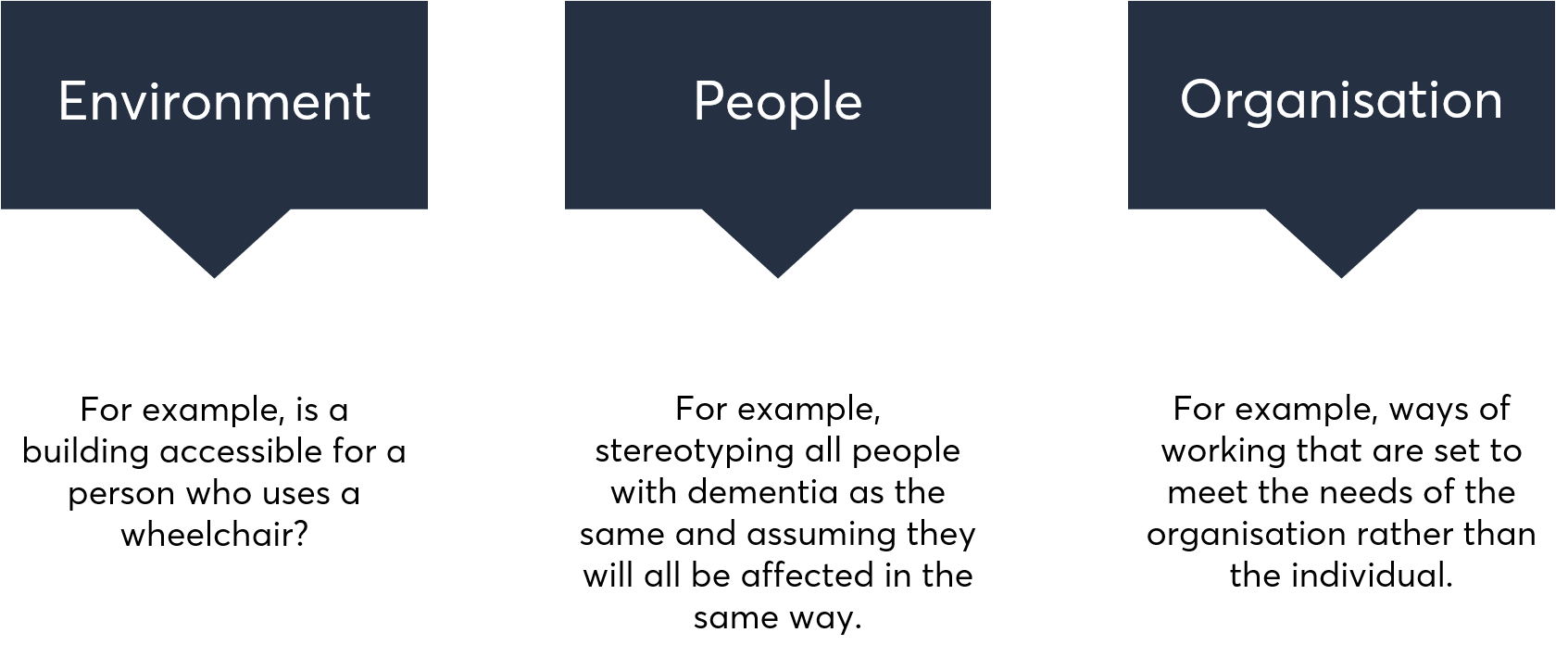
Below are some examples of barriers that could limit an individual’s choices and stop them from being included in society:
If you think a person’s care and support needs have changed and need reassessing, you should record this information and pass it on.
It is important to follow your agreed ways of working discussed directly with your branch owner on recording to reduce lost or misinterpreted information.
When recording information there are a number of points to consider:
- Ensure the information is accurate.
- It should be clear, concise, and legible.
- It should be non-ambiguous and state facts not opinions or assumptions.
- The person involved should be given the opportunity to contribute.
- Apply the principles of the Data Protection Act and maintain confidentiality.
It can be upsetting living with symptoms like memory loss and changes in personality, particularly if you don’t understand why they are happening. As there are a number of conditions that have similar symptoms it is important that an accurate diagnosis is made. Whilst this can be difficult to hear it can clear up uncertainty and help someone to feel more in control. We do not diagnose clients, but we can suggest they seek support from their GP if you have concerns surrounding their behaviour.
The below table shows some common conditions and their symptoms:
Condition Symptoms Psychosis - Confusion as a result of hallucinations and delusions.
- Lack of insight and self-awareness.
- Problems with sleeping.
Depression / Mood Disorders - Change in mood / personality.
- Problems with sleeping.
Anxiety - Change in mood / personality.
- Problems with sleeping.
Dementia - Confusion as a result of memory loss.
- Change in mood / personality.
- Problems with verbal communication.
- Problems with sleeping.
Learning Disabilities - Confusion due to difficulties with memory or relating to information.
- Lack of insight and self-awareness.
- Problems with verbal communication.
Care and support must be person-centred and will need to be reviewed and adapted to meet the changing needs of the individual. It may be necessary to develop your skills so that you can provide effective care and support. For example:
- Individuals may need to be supported to learn how to use this technology to live independently.
- Developing skills to support people to communicate.
The Mental Capacity Act 2005
You must assume that individuals can make a decision unless they are unable to do one or more of the following:
- Understand information given to them.
- Retain information long enough to make the decision.
- Weigh up the information available.
- Communicate their decision.Learning how to use assistive technology.
Mental capacity is a term used to describe an individual’s ability to make their own decisions. When assessing a person’s capacity ask yourself:
Does the person have an impairment, or a disturbance in the functioning of their mind or brain?
This can include, for example, conditions associated with mental illness, concussion, or symptoms of drug or alcohol abuse.
Does the impairment or disturbance mean that the person is unable to make a specific decision when they need to?
You should offer appropriate and practical support to achieve this before applying this stage of the test.
There are five key principles that everyone must follow when assessing capacity, these are:
1. Always assume that the person can make their own decision.
2. Ensure all possible support is provided to make sure the person can make their own decision.
3. Do not assume someone cannot make a decision because you feel they are making an unwise or unsafe decision.
4. If it has been identified that the person cannot make a decision, someone can make a decision that is deemed to be in that person’s best interest.
5. If a person makes a decision on behalf of the individual, this must be the least restrictive option.
A Mental Capacity Assessment is decision-specific and the principles must be applied to individual decisions. It is important to remember that an individual may lack the capacity to make a specific complex decision but this does not mean that they lack the capacity to make all decisions.
Legislation and policies promote human rights, inclusion, equal life chances and citizenship of individuals with mental health needs, dementia or learning disabilities.
These include:
References in this page are made to the Care Act 2014 and Mental Capacity Act 2005 but also refer to the relative differences in each different part of the UK. Please see below the equivalent in the other UK countries:
Care Act 2014 (England)
- Social Services Wellbeing (Wales) Act 2014.
- Public Bodies (Joint Working) (Scotland) Act 2014.
- Health and Social Care (Reform) Act (Northern Ireland) 2009.
Mental Capacity Act 2005 (England and Wales)
- Adults with Incapacity (Scotland) Act 2000.
- Mental capacity Act (Northern Ireland) (MCA (NI)) 2016.
